
to leave a comment.
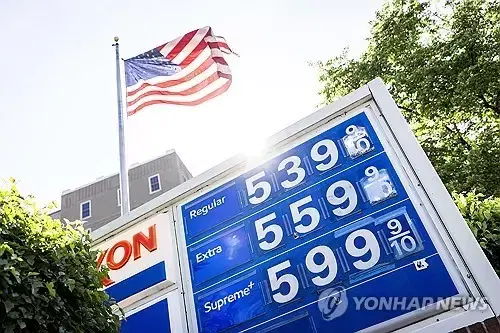
Gas price sign at a gas station in Washington D.C. on the 20th (local time)
Recently, after contemplating joining a Costco warehouse club membership in the U.S., I finally got the card.
Although the annual fee of $65 (approx. 96,000 won) was a burden and I was delaying joining, I was swayed by talk that "Costco gas stations have cheaper gas prices than regular gas stations."
U.S. prices were always a burden due to tips added to every meal and high exchange rates, but there was an perception that gas prices, at least, were cheaper than in Korea.
However, the situation changed after the Iran conflict began at the end of February.
Gas prices in the U.S. continued to rise, surpassing $4 per gallon (approx. 1,400 won per liter) from prices that were less than $3 per gallon (approx. 1,200 won per liter), and refueling became an expense that could no longer be taken lightly.
Last weekend, cars were lined up in long queues at the Costco gas station I visited.
The sight of consumers looking for cheaper gas stations to save even a few cents is not unfamiliar, but the queues these days felt quite different from before.
This is because international oil prices have fluctuated due to the aftermath of the Iran conflict, significantly increasing consumers' sensitivity to energy prices.
President Donald Trump has stated that Iran's blockade of the Strait of Hormuz would not significantly affect the U.S., unlike Europe and Asia, which are highly dependent on the strait for energy transport.
A gas station in Miami, Florida, USA
However, reality is moving in a different direction.
The global crude oil market is closely interconnected, and geopolitical risks from the Middle East are immediately reflected in global oil prices. The escalating tensions surrounding the Strait of Hormuz are not just a regional issue but a variable that shakes the global supply chain.
The impact is clearly visible on gas station price signs in the U.S.
The problem is that such uncertainty is unlikely to be resolved in the short term.
Currently, the U.S. and Iran are maintaining a precarious truce. With the U.S. also expanding its naval blockade targeting Iran, tensions in the Strait of Hormuz and surrounding waters are further escalating.
Even if military clashes subside, the prevailing forecast is that high oil prices will continue for some time.
U.S. Energy Secretary Chris Wright said in a recent media interview regarding when gasoline prices in the U.S. are expected to return below $3 per gallon, "It could be by the end of this year, or it might not be possible until next year."
For President Trump, this is also a political burden. With the November midterm elections approaching, rising prices are the variable most keenly felt by voters.
Especially in the U.S., where reliance on private cars is higher than on public transportation, gas prices are more than just an economic indicator. Gas station price signs directly lead to household burdens, which in turn are directly linked to consumer dissatisfaction and evaluation of the administration.
Rising oil prices stimulate logistics and production costs, pushing up the prices of other goods, thus increasing the likelihood of spreading into overall inflationary pressure.
In this respect, President Trump's hardline stance against Iran has an ironic aspect.
While a strategy of maximizing pressure to enhance negotiating power might be effective in the short term, it could also boomerang, increasing instability in the energy market and stimulating domestic prices.
Ultimately, President Trump is expected to face deeper concerns between his diplomatic and security strategies and domestic economic and political burdens. All eyes are on what balance he will strike amidst the 'oil price dilemma' and how his choices will affect public sentiment in the midterm elections.
Newsletter
Get key news delivered to your email every morning
to leave a comment.