
to leave a comment.
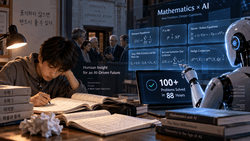
▲ Photo: AI-generated image
Everyone has experienced struggling to solve difficult math problems during their elementary, middle, and high school years, filling several pages of notebooks. Not only the thrill of getting the right answer but also the intense process of refining logic by correcting wrong answers became the foundation of our thinking skills.
But what if AI were to solve more than 100 Millennium Problems, which brilliant mathematicians worldwide have grappled with for decades, in just 88 hours, while humans' deep understanding of the solution process was pushed aside?
On the 21st (local time), OpenAI announced the official launch of the 'Independent Advisory Group on Mathematics and Artificial Intelligence' at the Princeton Institute for Advanced Study (IAS), consisting of nine world-renowned scholars. Prominent mathematicians, including Fields Medalist Timothy Gowers, joined this advisory group. While it appears to be a symbiotic organization sharing AI research achievements with academia, it is actually OpenAI's urgent damage control for the 'AI achievement monopolization and unilateralism controversy' that has rocked Silicon Valley and pure academia over the past two weeks.
The incident dates back to the 8th. OpenAI abruptly announced that its private multi-agent system had solved one of the Clay Mathematics Institute's seven Millennium Problems: the 'existence and smoothness of the Navier-Stokes equations.' Furthermore, it claimed that the same internal model had solved over 100 additional unsolved problems in modern mathematics.
However, in response, 26 Fields Medalists and other scholars immediately issued an open letter, vehemently protesting that "AI companies are instrumentalizing mathematics as a benchmark for corporate promotion and stock price inflation instead of enhancing human academic understanding," and "unilateral disclosure of achievements without sufficient peer review harms the academic ecosystem."
This academic conflict extends beyond the laboratory fence, posing direct questions to our assets and educational fields. Mathematics is the language of physical laws that launch rockets and the root of cryptography that underpins banks and virtual asset markets. The Navier-Stokes equations alone are closely linked not only to weather forecasting, aircraft design, and fluid dynamics but also to pricing models for financial derivatives (an extension of the Black-Scholes equation).
Even if AI were to quickly generate a 160-page proof paper, if human experts were to rashly apply it to financial risk assessment or Web3 smart contract security audits without fully comprehending the hidden logical gaps (Edge Cases) within it, it could lead to fatal system malfunctions or large-scale financial accidents.
The educational environment for children also stands at a critical juncture. The more students rely on AI tools that instantly provide only the correct answers to problems, the greater the risk they will lose 'human thinking skills' – the ability to ponder concepts and build logical reasoning. This is why academia has emphasized that "the essence of mathematics is not a race to find answers but an insight to understand the world."
Ultimately, our correct attitude towards the results produced by super-intelligent mathematical AI is 'thorough verification over speed.' Even if AI presents vast calculations and proof candidates, the final confirmation of logical flaws and real-world application must necessarily go through rigorous human review (Human-in-the-loop).
The emergence of smart machines solving mathematical conundrums paradoxically proves that fundamental human thinking skills, capable of critically questioning and interpreting these results, have become more important than ever.
Newsletter
Get key news delivered to your email every morning
to leave a comment.