
to leave a comment.
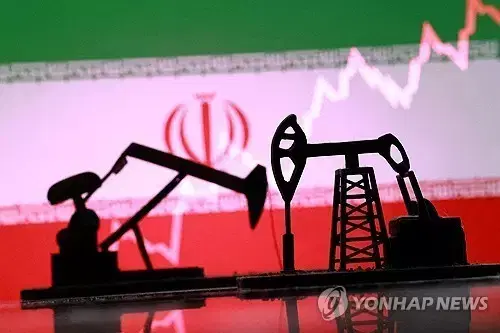
Amidst the stalemate in the second peace talks between the United States and Iran, international oil prices, which had fallen for the first time in five trading days, are rising again.
According to Bloomberg News, Brent crude futures for June delivery were trading at $107.40 per barrel as of 2:25 PM KST on the 27th, up 1.97% from the previous session.
U.S. West Texas Intermediate (WTI) futures for June delivery rose 1.69% from the previous session to $96.00 per barrel.
On the 24th, Brent and WTI futures had turned lower for the first time in five trading days on expectations of a second peace talk, but with the failure of the second face-to-face talks, international oil prices appear to be rebounding.
The Strait of Hormuz, through which approximately 20% of the world's crude oil and petroleum products pass, remains blocked, exacerbating energy supply disruptions.
According to the American Automobile Association (AAA), as of the 26th, the price of gasoline in the U.S. was $4.10 per gallon, a 37% surge from before the Iran War began. Diesel prices also soared 45% to $5.46 per gallon.
Meanwhile, Dan Struben, an analyst at Goldman Sachs, presented a report on the 27th, forecasting the average Brent crude price for Q4 of this year at $90 per barrel. This is an increase of $10 from the previous forecast of $80.
The forecasts for Q2 and Q3 were also revised upwards to $100 and $93, respectively.
Analyst Struben explained the reason for the upward revision, stating, "We assume that Gulf exports will normalize by late June, not mid-May as previously expected, and that production recovery will be slower than anticipated."
He also estimated a global supply shortage of 9.6 million barrels per day for this Q2.
Morgan Stanley estimated that crude oil exports from Gulf countries decreased by 14.2 million barrels per day due to the closure of the Strait of Hormuz, resulting in a global inventory reduction of 4.8 million barrels per day.
Morgan Stanley maintained its previous forecast that Brent crude would average $110 in Q2, $100 in Q3, and $90 in Q4, respectively.
Meanwhile, U.S. President Donald Trump said on the 26th that negotiations with Iran would be "conducted by phone. So if they want, they can call us."
President Trump stated this in a phone interview with Fox News today, saying, "I'm not going to send people (U.S. negotiating delegation) to travel for 18 hours."
Initially, the U.S. had planned to send a negotiating delegation to Pakistan, the negotiation site, on the 25th, but decided to postpone the dispatch when Iran seemed unwilling to negotiate.
Ultimately, President Trump's mention of 'phone negotiations' today is interpreted as a message to pressure Iran by expressing an unwillingness to be tied to negotiations.
Newsletter
Get key news delivered to your email every morning
to leave a comment.