
to leave a comment.
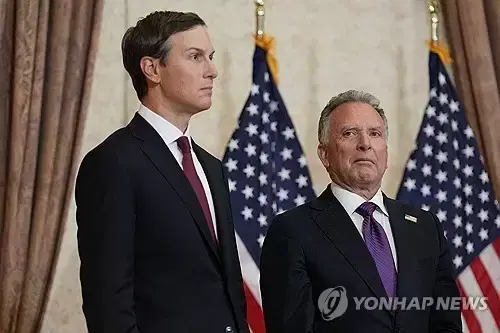
Jared Kushner (left) and Middle East Envoy Steve Witkoff (right)
As the United States intensifies pressure on Iran with strengthened maritime blockades and additional sanctions, the international community's attention is focused on whether a second round of negotiations will be held this weekend or early next week to reach an agreement on ending the war and denuclearizing Iran.
With Iranian Foreign Minister Abbas Araghchi having arrived in Islamabad, the capital of Pakistan, which is mediating the negotiations, and the US negotiating team also expected to head to Pakistan, there is speculation that the possibility of a meeting between the two sides has increased.
The White House announced on the 24th (local time) that the US negotiating team, including Middle East Envoy Steve Witkoff and Jared Kushner (President Trump's son-in-law), is scheduled to depart for Pakistan on the 25th for face-to-face talks with Iran.
Iranian officials, who requested anonymity, also told The New York Times (NYT) that Minister Araghchi is scheduled to meet with the US delegation and will present a new written response to the US proposal for a peace agreement.
However, Iranian state media reported that Minister Araghchi will not meet with the US side during his visit to Pakistan, indicating an ongoing power struggle over the success of the negotiations.
However, it is currently unclear whether this power struggle should be viewed as a tactical maneuvering by both countries to gain a more advantageous position on the premise of holding talks, or as an 'off-the-record war of nerves' occurring in a situation where even the holding of talks has not been agreed upon.
Amidst this, President Trump is further intensifying economic and military pressure on Iran while also emphasizing his willingness for a diplomatic resolution through negotiations.
The United States is focusing on tightening Iran's financial lifelines by expanding its blockade operations not only in the Strait of Hormuz but also into international waters, blocking vessels from entering and exiting Iranian ports and seizing those that violate the blockade. It has also announced its policy to immediately sink any vessel that installs naval mines in the strait.
Defense Secretary Pete Hegseth said today, "The blockade is expanding and extending worldwide," adding, "Time is not on Iran's side due to these blockade measures." He reaffirmed the position that the blockade would continue as long as deemed necessary.
In addition to this, the US is continuing its all-out pressure by imposing further sanctions. The Trump administration announced additional sanctions today on approximately 40 shipping companies and vessels operating a 'shadow fleet' to export Iranian oil while circumventing sanctions.
Amid escalating tensions over the blockade of the Strait of Hormuz in the precarious truce between the US and Iran, attention is focused on whether both sides will resume the second round of negotiations and attempt to find common ground.
As the first round of peace talks on the 11th-12th failed, and the second round of negotiations expected to be held on the 21st also fell through, if this meeting succeeds, it remains to be seen whether it can break the deadlock and create a breakthrough in the negotiations.
President Trump
The White House initially expressed optimism about resuming negotiations.
The White House believes that some progress has been detected in Iran's position in recent days and intends to confirm this specifically through the upcoming negotiations.
President Trump stated in an interview with Reuters today that "Iran will make a proposal" and that he would observe. President Trump has previously claimed that peace negotiations have not progressed due to internal conflicts between Iran's hardliners and moderates.
White House spokesperson Caroline Leavitt said, "There appears to have been clear progress from Iran in recent days."
The main issues are expected to be Iran's nuclear program, the normalization of navigation in the Strait of Hormuz, and the easing of sanctions on Iran.
Spokesperson Leavitt emphasized that the US's top priority is "Iran firmly promising to surrender enriched uranium and never acquire, possess, develop, or manufacture nuclear weapons."
Observations also suggest that conflicts surrounding the Strait of Hormuz, in addition to the nuclear issue, could emerge as a greater challenge.
The United States views the maritime blockade against Iran as a leverage point to pressure Iran, but Iran is protesting, stating that it contradicts the spirit of the truce.
It is also noteworthy that the US is expanding its maritime blockade and demanding participation from its allies.
Secretary Hegseth said today, "Europe and Asia have enjoyed our protection for decades, but the era of free riders is now over." He reiterated his call for support from allies, including troop deployments, for operations in the Strait of Hormuz.
This is interpreted as an indication that as the United States strengthens its maritime blockade against Iran amidst a precarious truce with Iran, the military and political burden on its allies is also increasing.
Newsletter
Get key news delivered to your email every morning
to leave a comment.