
to leave a comment.
Unveiling 'Sim-to-Real' Technology that Applies Simulation Learning to Reality
Advancing Physical AI with Synthetic Data and Groot 1.7
"Reducing the gap (Sim-to-Real gap) between the real environment with physical constraints and simulation is key to the commercialization of humanoid robots."
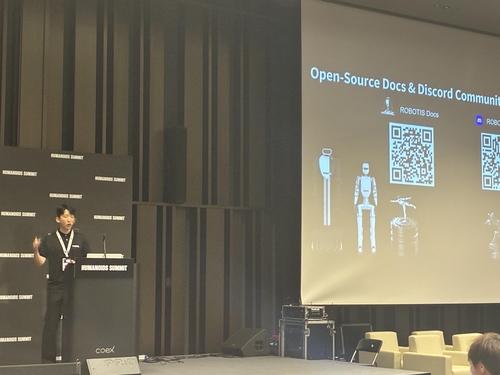
At the Seoul Humanoid Summit held at the COEX Grand Ballroom in Seoul on the 22nd, Robotis [108490] and NVIDIA presented an artificial intelligence (AI) software stack and architecture that will become the brain of next-generation humanoids.
In today's session, Woosung Ho, Lead at Robotis, and Qi Wang, Senior Product Manager at NVIDIA, spoke as presenters, revealing the achievements and vision of the two companies' technological collaboration.
Robotis shared the process of solving the technical challenge of applying what robots learn in virtual environments to the physical world.
Woosung Ho said, "As a result of changing the existing physics engine to MuJoCo (a high-performance open-source physics engine), stability in actions like boxing has improved by more than double."
Given the nature of the robotics industry, where securing high-quality data is essential, Robotis actively adopted NVIDIA's Cosmos Transfer.
Woosung Ho stated that by augmenting existing remote control videos into approximately 300 data points and fine-tuning the model, they resolved the phenomenon of robots mistaking shadows for targets and significantly improved recovery capabilities in case of task failure.
Woosung Ho added that while full-body motion control is easily scalable through large-scale simulations, the introduction of a World Action Model, which predicts the results of actions, is essential in the manipulation phase where complex physical contact occurs.
Wang, NVIDIA's Senior Product Manager, analyzed the Isaac Groot architecture, a general-purpose robot intelligence model.
Project Groot aims for general-purpose robot intelligence that can be ported to various robot forms, independent of single tasks or specific hardware.
He also emphasized the importance of acquiring data for model advancement.
Wang explained, "Ultimately, robotics is a data problem," adding, "We are utilizing a data pyramid strategy that combines high-quality real robot data, synthetic data, and human-scale data."
The newly commercialized Groot 1.7 generates actions directly by leveraging the powerful inference capabilities of the Cosmos Vision2B model, based on a Vision-Language-Action (VLA) model.
Cha Soo-jung, Machine Learning Architect at AWS Generative AI Innovation Center, who attended the afternoon session, pointed out the importance of establishing a cloud-based end-to-end model learning pipeline, stating, "While traditional AI remained within laptops, physical AI differs in that it directly interacts with the physical world."
Newsletter
Get key news delivered to your email every morning
to leave a comment.