
to leave a comment.
Tariffs imposed on polysilicon derivative products... Targeting China and its bypass exports
Minimum import price set to block Chinese dumping... $21 per 1kg of polysilicon
Effective after US-China summit and US midterm elections... Impact on Korean companies draws attention
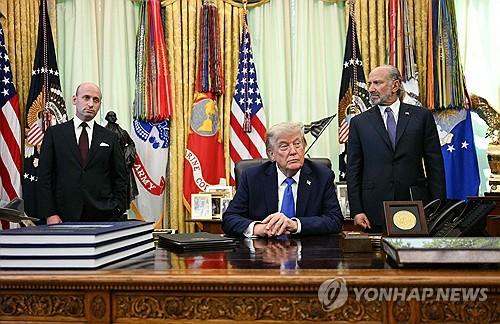
US President Donald Trump signed a proclamation on the 6th (local time) to set a Minimum Import Price (MIP) to prevent dumping and impose an additional 15% tariff on polysilicon and polysilicon derivatives, which are key materials for semiconductors and solar panels.
Accordingly, this is expected to affect Korean companies exporting polysilicon and its derivative products to the US, as well as Korean companies that have established factories and produce within the US.
In the proclamation, President Trump stated, "I find it necessary and appropriate to impose a 15% tariff on imports of polysilicon derivative products to ensure that such imports do not threaten to impair the national security of the United States."
MIP was also applied to polysilicon and derivative products. MIP is a price floor that prevents imports into the US at prices lower than that set. Setting a minimum import price is interpreted as a measure to prevent dumping of low-priced imports, mainly from China, and to protect domestic production bases in the US.
The US set the MIP for polysilicon at $21 per 1kg.
For polysilicon ingots (cylindrical blocks of polysilicon) and wafers, the price was set at $100 per 1kg.
For solar cells, $0.22 per watt was set as MIP, and for solar modules, $0.38 per watt was set as MIP, respectively.
The proclamation also stated, "A 15% additional tariff is imposed on imports of polysilicon ingots and polysilicon derivative products," and clarified that the 'minimum price system and 15% additional tariff' "shall apply in addition to any other duties, taxes, fees, levies, and charges applicable to such products."
This is interpreted to mean that the US government will levy an additional 15% tariff on polysilicon derivative products manufactured in China or certain Southeast Asian countries identified as bypass export routes for China, in addition to existing high tariffs.
South Korea, along with Japan, Taiwan, Switzerland, Liechtenstein, and European Union (EU) member states, will be subject to a 15% tariff, while the UK will be subject to a 10% tariff.
This proclamation is a measure under Section 232 of the Trade Expansion Act, which grants the President the authority to restrict imports through appropriate actions, such as tariffs, if the import of certain items is deemed a threat to national security.
The US Department of Commerce initiated a Section 232 investigation into polysilicon in July of last year, and this proclamation is the result.
President Trump stated, "Polysilicon is a foundational material supporting the security of America's semiconductor and solar power supply chains," and clarified that this measure is intended to rebuild the US polysilicon industry.
Indeed, the US production capacity for polysilicon and its derivative products has significantly declined. President Trump pointed out in the proclamation, "The US share of global polysilicon production capacity has fallen from 50% in 2005 to less than 2% in 2024."
He added that the US share of semiconductor wafer manufacturing decreased from 37% in 1990 to 10% in 2024, and in the solar sector, the US is entirely dependent on imports for solar ingots, wafers, and cells.
However, this measure will take effect at 00:01 AM on December 4, 120 days from now, Eastern US time.
Delaying the actual effective date by four months appears to be based on various strategic considerations.
US political news outlet Politico pointed out that the timing is "after the November midterm elections and the US-China summit between President Trump and Chinese President Xi Jinping scheduled for September, as the Trump administration grapples with voter discontent over rising inflation and flimsy trade negotiations with China."
In addition, the proclamation grants the US Secretary of Commerce the authority to establish programs to incentivize investment in the production of not only polysilicon raw materials but also ingots, wafers, and cells within the United States.
This means that companies building polysilicon-related manufacturing facilities in the US will be allowed to import without being subject to the tariffs imposed by this measure.
In this regard, the proclamation stipulated conditions, such as a commitment from companies to construct, renovate, or expand facilities to produce products within the US, and a commitment to commence construction by January 20, 2029.
Accordingly, polysilicon-related companies with investment plans in the US or those that have already invested in production facilities are expected to engage in various contacts with the US Department of Commerce for tariff exemptions during the four months until the actual tariff measure takes effect.
The impact of this measure on South Korean companies is also drawing attention.
Immediately after the Section 232 investigation was initiated last year, the South Korean government mentioned Hanwha Q Cells' investment in a solar panel production facility in Georgia and OCI's investment in a solar cell production facility in Texas, requesting that Korean companies contributing to the US supply chain diversification strategy be excluded from import restriction measures such as tariffs.
Hanwha Q Cells, for its part, welcomed the measure.
Andy Park, Global CEO of Hanwha Q Cells, told the New York Times (NYT) that "Today's White House decision reflects the reality of US solar energy manufacturing while balancing our shared goal of bringing the entire supply chain, from polysilicon to finished panels, back to the US."
Newsletter
Get key news delivered to your email every morning
to leave a comment.