
to leave a comment.
Customs Service announces support measures for diversifying non-Middle Eastern crude oil supply chains
Easing direct transport proof and reclassification of naphtha substitutes to be promoted
In the future, US crude oil entering Korea via a third country will be eligible for duty-free benefits under the Korea-US Free Trade Agreement (FTA).
Australian naphtha substitutes will also be subject to zero tariffs, which is expected to ease the burden of raw material supply and demand for the petrochemical industry.
On the 26th, the Korea Customs Service announced measures to diversify crude oil supply chains and support the import of petrochemical raw materials, aimed at responding to instability in the Middle East.
The core of the measures is to ease non-tariff barriers and administrative procedures in the import process of US crude oil and naphtha substitutes.
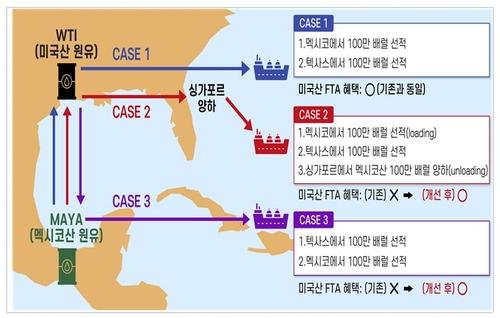
The Customs Service announced that starting today, it will introduce a 'special provision for direct transport' that relaxes the 'FTA direct transport principle'.
Previously, preferential tariffs under the Korea-US FTA were only applied if it was proven that US crude oil was transported directly from the contracting country to Korea.
However, as US crude oil often transits through third-country ports during transportation, the refining industry had to submit separate documents for the entire transport route and customs documents from transit countries. Due to the nature of crude oil imports, which do not stop at bonded areas that issue such documents, it was virtually impossible to submit them.
It was reported that a domestic refining company, Company S, imported US crude oil last year but failed to prove direct transport for four cases (4 million barrels), thus forfeiting FTA tariff benefits.
With this special provision, the Customs Service has changed its judgment criteria from a document-centric review to verifying actual transportation. Accordingly, the industry will be able to prove direct transport using only existing data such as vessel position information (AIS) or crude oil measurement data.
The Customs Service expects that even if US crude oil tankers unload some cargo in a third country or load additional heavy oil from another country, FTA preferential treatment can still be applied to the US volume, which will help diversify crude oil import sources.
The Customs Service also decided to classify naphtha substitutes as 'petroleum products' by applying a fast-track pre-assessment system for item classification.
Until now, naphtha substitutes were often classified as crude oil due to unclear item classification standards from the World Customs Organization (WCO). Consequently, a 3% tariff and storage obligations were applied, creating a burden for the industry to import them.
With this measure, Australian naphtha substitutes with a naphtha content of 80% or more will also receive duty-free and storage obligation exemption benefits.
The Customs Service expects this to enable the securing of approximately 2.5 million tons of alternative raw materials annually.
The Customs Service also stated that it plans to pursue consultations with local authorities to resolve delays in issuing Certificates of Origin (CO) for Malaysian crude oil.
Newsletter
Get key news delivered to your email every morning
to leave a comment.