
to leave a comment.
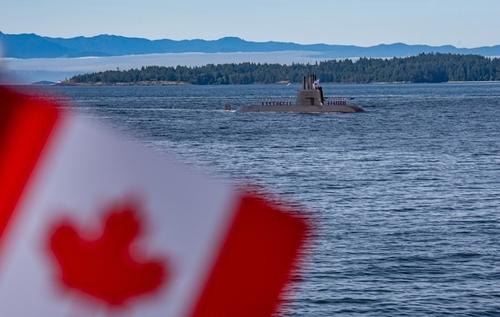
Considering Canada's urgent need for procurement, Korea highlights delivery time and verification...Germany counters with economic and industrial cooperation
"It's like driving a 1999 Honda Civic and then buying a new Tesla."
Regarding the arrival of the domestically produced submarine Dosan Ahn Chang-ho (SS-III) at the Canadian Victoria Esquimalt Naval Base after a 14,000 km one-way voyage, Canadian local media outlets, including the daily The Globe and Mail, public broadcaster CBC, and private broadcaster CTV, uniformly reported on the 24th (local time) that the Korean submarine is superior to the submarines currently owned by Canada.
According to local media, Petty Officer Jake Dickson, who sailed aboard the Dosan Ahn Chang-ho from Hawaii, USA, to the Esquimalt base on the 7th, compared the Dosan Ahn Chang-ho to a new Tesla.
Major Brittany Bourgeois, who also experienced the Dosan Ahn Chang-ho for about two weeks, praised the advantages of the Korean submarine, saying, "It's not rusty and has ample space," and "Boarding the latest submarine has opened our eyes to the possibilities that lie ahead for us."
This assessment is interpreted as a favorable outcome for Korea, coinciding with the Canadian government's push for the 'Canadian Patrol Submarine Project' (CPSP) to procure up to 12 new diesel submarines to replace its aging fleet.
Currently, the final contenders for the contract have been narrowed down to Hanwha Ocean's 'KSS-III' and German ThyssenKrupp Marine Systems' (TKMS) 'Type 212CD' two models, and the Canadian government is expected to select the final contractor as early as next month.
The submarines currently operated by Canada are only four Victoria-class submarines acquired second-hand from the UK in 1998. Of these, three are under repair, leaving only one vessel actually deployable for operations.
Rear Admiral David Patchell, Commander of the Canadian Pacific Fleet, told CBC about the urgency of acquiring new submarines, saying, "We needed them yesterday."
Commander Patchell expressed his expectation, "We have operated submarines for over 100 years, but we have not been a true submarine-owning nation. If we acquire 12 modern submarines, Canada could become a submarine-owning nation."
Local experts cited Hanwha Ocean's guarantee of faster delivery than its German competitor TKMS as an advantage, given the urgent need for submarine procurement.
Kevin Budning, Director of Research at the CDA Institute, a Canadian defense think tank, stated in an article for the policy journal 'Policy' that "Korea plans to deliver its first submarine by 2032, followed by four by 2035, and additional vessels every year thereafter," adding, "Hanwha has a significant advantage in this regard."
He further mentioned that "this submarine is not a conceptual design or a platform in the development stage, but is already operational and being produced on a mass production line."
While acknowledging TKMS's high reputation in submarine design and engineering, he pointed out that the Type 212CD is "an unverified new platform only now entering mass production."
He added, "TKMS has not transparently disclosed its delivery times, but some forecasts suggest that Canada will not receive its first submarine until the mid-to-late 2030s."
Glenn Copeland, CEO of Hanwha Defense Canada, is fully leveraging the Dosan Ahn Chang-ho's arrival at the Canadian naval base in the bidding process.
He introduced his company's submarine as "a proven solution that is visible here and now," emphasizing that "this is a risk-free solution for the Canadian government."
Hanwha Ocean also signed a memorandum of understanding to locally produce armored vehicles in Canada if it wins the submarine contract and to invest 345 million Canadian dollars (approximately 380 billion KRW) in Algoma Steel in Ontario.
A study result was also released, stating that its investment in Canada would create 15,000 to 22,500 annual jobs by 2044.
However, the proposal from TKMS, backed by the German government, is also formidable.
The German government proposed a 30-year economic and industrial support package to assist TKMS.
Specifically, it is promoting investments in electric vehicle battery production in Canada, rare earth mining, and infrastructure support related to resource security. It is also considering importing Bombardier aircraft from Canada.
TKMS also emphasizes that the 'Type 212CD' is an improved version of the 'Type 212,' which is already operated by allied navies.
Newsletter
Get key news delivered to your email every morning
to leave a comment.