
to leave a comment.
Expansion of trade in automotive parts and food… "Also aims to reduce reliance on China's supply chain"
Mexico and the European Union (EU) have signed an amendment to a trade agreement to reduce mutual tariffs in an effort to decrease their dependence on the United States.
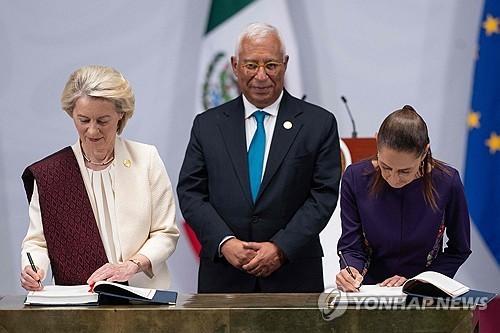
According to AFP, Mexican President Claudia Sheinbaum and European Commission President Ursula von der Leyen signed the expanded and revised agreement at the 8th EU-Mexico Summit held in Mexico City on the 22nd (local time).
This revised agreement supplements the existing agreement signed in 2000 and aims to eliminate most of the remaining barriers in trade and investment.
It aims to promote trade in the automotive parts sector, which was hit by tariffs imposed by the Trump administration, and will apply duty-free benefits to products such as pasta, chocolate, potatoes, canned peaches, eggs, and some poultry products.
Mexico also agreed to recognize the protection of appellations of origin for hundreds of special products from specific EU regions.
In a joint statement, both sides stated, "In a time of increasing uncertainty and significant change, we have decided to expand, deepen, and modernize our strategic partnership."
This is interpreted as an attempt to diversify trade structures in response to the Trump administration's tariff policies.
The EU recently negotiated with the United States to apply a 15% tariff on most European products, and Mexico is also frequently facing tariff pressure even while the United States-Mexico-Canada Agreement (USMCA) remains in effect.
President Sheinbaum has emphasized the need for trade diversification, stating that "we must open up other horizons" amid these tariff offensives.
An anonymous EU official told AFP, "Mexico is trying to reduce its dependence not only on the United States but also on China's supply chain," adding, "Europe is also pursuing the same goal."
Newsletter
Get key news delivered to your email every morning
to leave a comment.