
to leave a comment.
KRW stablecoins already circulating offshore... "A framework of trust must be established through institutions"
It has been suggested that virtual assets worth 160 trillion won are flowing out of Korea annually, and that KRW stablecoins should be created to prevent foreign currency outflow and participate in the changing global payment ecosystem.
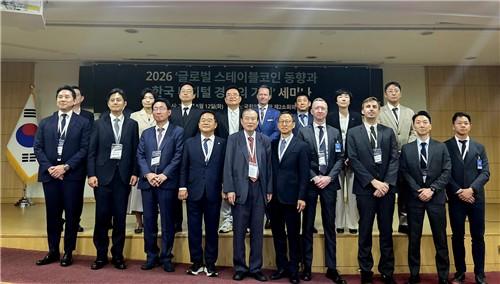
On the 12th, Attorney Kim Tae-rim, CEO of Law Firm Axis, made this statement, citing a joint report by Tiger Research and CoinGecko, at a seminar titled 'Global Stablecoin Trends and Opportunities for Korea's Digital Economy' hosted by Democratic Party lawmakers Lee Kang-il and Min Byeong-deok at the National Assembly Members' Office Building in Yeongdeungpo-gu, Seoul.
Attorney Kim stated that while legislative debates are ongoing, KRW stablecoins are being created and circulated offshore, adding, "The more control is strengthened, the more the market itself moves outside national borders. We must create trust through safety devices and allow the market to operate on that foundation."
He cited the principles of Korean-style institutional design as: ▲Safety devices (issuer requirements, 100% reserves, clear redemption obligations) ▲Channels to induce flow internally (responsibility for circulation through domestically registered intermediary institutions) ▲Linkage of public and private sectors (compatibility with deposit tokens and CBDCs).
This seminar was co-organized by the Digital Convergence Industry Association, the Korea Web3 Blockchain Association, and the Digital Currency Governance Group (DCGG), and sponsored by the Digital Asset eXchange Alliance (DAXA).
Kim Ki-hong, Chairman of the Digital Convergence Industry Association, pointed out in his welcoming speech, "Despite the capabilities of major domestic (virtual asset) businesses, the ambiguous regulatory area is a limiting factor for industrial development."
He further explained, "The subsequent competition is likely to be more about financial infrastructure and institutional design than technology itself," emphasizing the need for institutional reform for the successful establishment of KRW stablecoins.
Joshua Townson, Global Policy Lead at DCGG, suggested that the UK's virtual asset policy differs from the uniform regulation of the European Union (EU) MiCA, stating, "A framework of trust must be established for companies to grow."
Participants on this day argued that KRW stablecoins could be an opportunity for the Korean economy, and that institutionalization should be expedited to avoid falling behind in a financial market being reshaped by stablecoins.
Vincent Chok, CEO of First Digital, a Hong Kong-based virtual asset company, said, "KRW stablecoins could serve as a bridge for potential global investors interested in Korea."
Rahul Advani, Co-Head of Global Policy at Ripple, who participated in the presentation via video, said, "The (stablecoin) system being created in the National Assembly now will determine whether Korean companies will merely be observers or active participants."
Newsletter
Get key news delivered to your email every morning
to leave a comment.