
to leave a comment.
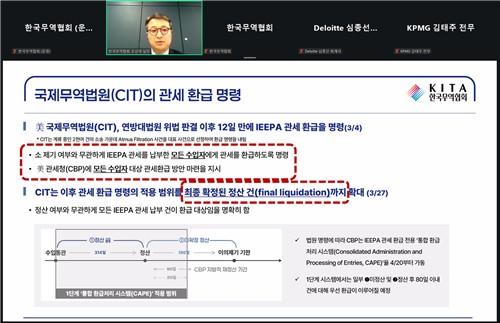
The Korea International Trade Association (KITA) held an 'Online Briefing on US International Emergency Economic Powers Act (IEEPA) Tariff Refunds and Section 232 Tariff Risk Response' for US exporting companies on the 6th.
This briefing was organized to guide companies through the refund application procedures and precautions, following the US government's initiation of IEEPA reciprocal tariff refund procedures on the 20th of last month. Approximately 250 representatives from domestic exporting companies attended the event.
Cho Sung-dae, head of KITA's Trade Research Department, explained that the 10% tariff under Section 122 of the Trade Act, which came into effect as a replacement for reciprocal tariffs, can only be imposed for up to 150 days.
He analyzed, "Congressional cooperation is needed to impose tariffs after July 24, but the possibility is not high," and "The US administration also seems to be proceeding with Section 301 procedures of the Trade Act in preparation for this."
Kim Tae-ju, Senior Managing Director at SamjongKPMG, emphasized that companies should expedite their refund applications, considering the possibility of an appeal by the US administration.
He warned, "If errors are found in the origin, product classification, or declared value during the US Customs and Border Protection (CBP) review process, it could lead not only to a hold on refunds but also to additional tariff assessments and penalties," urging thorough caution.
He also provided guidance on practical procedures, such as setting up refund accounts.
Shim Jong-sun, Partner at Deloitte Anjin, explained the recently revised Section 232 tariff method under the Trade Expansion Act.
He stated, "In the past, steel, aluminum, and copper derivative products had a complex structure where Section 232 product tariffs were imposed on the metal content portion and reciprocal tariffs on the non-content portion, leading to ongoing disputes over the calculation of the taxable value," adding, "Refunds may be delayed as the declared metal content value of existing customs clearances is also reviewed."
On February 20 this year, the US Federal Supreme Court ruled that the Trump administration's imposition of reciprocal tariffs based on the IEEPA, enacted in 1977, was illegal.
According to data submitted by CBP to the US Court of International Trade (USCIT), there are 330,000 eligible importers and a total of 53 million import cases.
Newsletter
Get key news delivered to your email every morning
to leave a comment.