
to leave a comment.
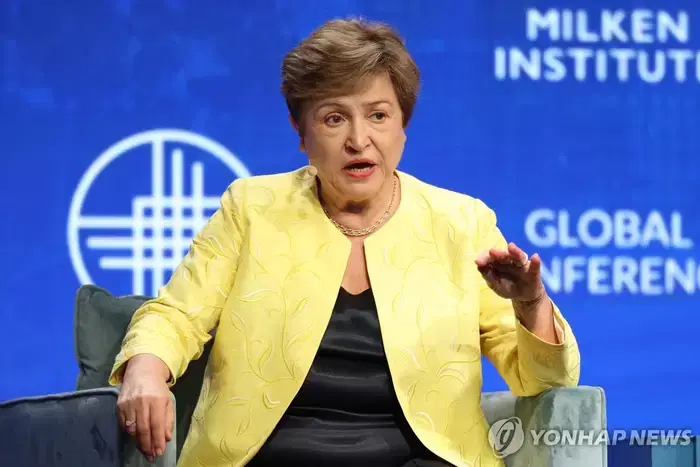
Kristalina Georgieva, IMF Managing Director
A warning has come from the head of the International Monetary Fund (IMF) that if the US-Iran war continues until next year, some countries will fall into a deep recession, and the entire world could be exposed to supply chain risks.
IMF Managing Director Kristalina Georgieva stated this on the 4th (local time) as a panelist at the economic and financial forum 'Milken Global Conference 2026' held at the Beverly Hilton Hotel in Los Angeles (LA), California, USA.
Managing Director Georgieva pointed out, "If (the US-Iran war) continues until 2027 and oil prices remain around $125 per barrel, we should expect much worse outcomes. We will see prices skyrocket, and supply chains will also be affected."
She continued, "Fertilizer prices have risen by 30-40% in one year, and now food prices will soon rise by 3-6%." She added, "80% of the world consists of oil-importing countries, and among them, there are countries without fiscal capacity. The US and China might be able to withstand it, but a significant portion of the world will fall into a deep recession."
She asked, "Why should we worry about this?" and emphasized, "Because it becomes a supply chain issue. If one piece of the world stops functioning, we all feel it together."
Last month, when the IMF released its World Economic Outlook, it predicted that if the conflict in the Middle East was short-lived, global growth would only slow to 3.1%. However, it also stated that this forecast is no longer valid as the war has dragged on longer than expected.
Managing Director Georgieva explained today, "The mild impact scenario is no longer valid. We anticipate this situation to continue throughout this year and are therefore assuming a negative scenario."
Mike Wirth, Chevron CEO
Mike Wirth, CEO of the oil company Chevron, who was also present, issued serious warnings regarding oil supply.
He noted that oil prices were able to remain around $115 per barrel even as the Iran war continued, thanks to temporary buffering, which can no longer be expected.
CEO Wirth explained, "The main buffers that mitigate price shocks when crude oil supply is interrupted include onshore inventories, inventories on ships at sea, and strategic petroleum reserves." He added, "Strategic petroleum reserves were released early in the (Iran) situation, and commercial inventories at the beginning of the year were higher than usual, which allowed us to absorb supply shocks so far."
However, he warned, "All of this has now been depleted. The last ship from the Gulf is being unloaded today at the Port of Long Beach, California, USA," adding, "The buffers that prevented price signals from reaching the market are losing their capacity."
He added, "The best-case scenario (regarding the Strait of Hormuz) was already discarded weeks ago. It's time to seriously consider a long-term, destructive scenario," and "Signs (of economic impact) are already appearing in Asia, and Europe is following right behind."
Newsletter
Get key news delivered to your email every morning
to leave a comment.