
to leave a comment.
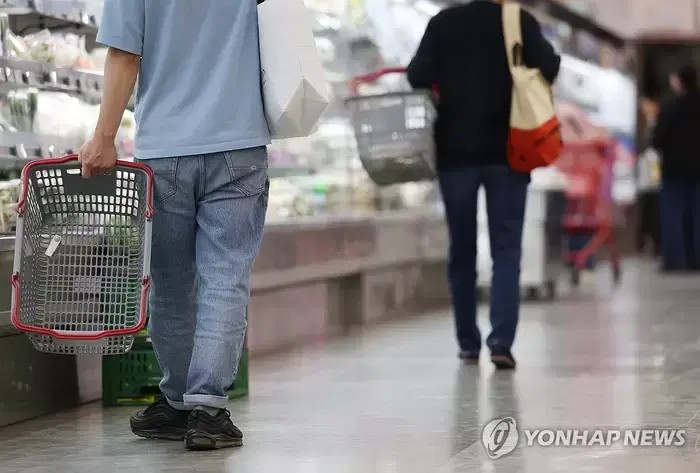
Citizens shopping at a large supermarket in Seoul
The dark shadow of the Iran war looms, with the Strait of Hormuz, a gateway for global energy transport, blockaded and international oil prices soaring, yet the stock market continues its solo bull run, showing a temperature difference.
According to the Bank of Korea's Economic Statistics System on the 2nd, the recently announced Economic Sentiment Index (ESI) for April 2026 was tallied at 91.7, a decrease of 2.3 points from the previous month.
Following a sharp drop of 4.8 points last month, which was the largest decline since December 2024 (-9.8 points) immediately after the declaration of martial law, the index has continued its downward trend for two consecutive months.
The Bank of Korea stated that despite improved export prospects for manufacturing, the index decline was driven by deteriorating household income and expenditure forecasts among general consumers.
The primary reason cited is the uncertainty surrounding when the soaring international oil prices will end.
International oil prices, which were around $70 per barrel until late February, have now surged to approximately $120 per barrel for June delivery Brent crude futures.
After the US and Iran agreed to a two-week ceasefire earlier this month, Brent crude futures initially plunged to $86.09 per barrel, showing signs of stabilization. However, as the second round of peace talks between the US and Iran failed and the blockade of the Strait of Hormuz became prolonged, prices resumed their sharp ascent.
Rising oil prices push up overall inflation while impacting household incomes and corporate costs, leading to slower growth and increased unemployment.
However, stock markets in major global economies continue to rise relentlessly amidst ongoing noise from the Middle East, maintaining their streak of all-time highs.
Notably, South Korea, which saw the largest decline among global stock markets immediately after the outbreak of the Iran crisis, as if denying that fact, surpassed its pre-war peak on the 21st of last month, and then touched the 6,700-point mark for three consecutive trading days from the 28th to the 30th, now aiming for '7,000 points'.
KOSPI index displayed on the situation board of Woori Bank's dealing room in Jung-gu, Seoul, on the 30th of last month
One of the key reasons for the growing disparity between the perceived economy and Yeouido (Seoul's financial district) is the 'K-shaped growth' driven by semiconductors.
As the world's industries are rapidly reorganizing in the era of artificial intelligence (AI), large semiconductor companies like Samsung Electronics [005930] and SK Hynix [000660], which have entered a super-boom, are firmly supporting the Korean economy despite successive crises since the launch of the Donald Trump administration.
With the prospect that the nation dominating AI will seize global hegemony, and as the United States and China accelerate AI infrastructure investment at a national level, the semiconductor boom is expected to continue for a considerable period.
Furthermore, in this war, the power of AI was clearly demonstrated, with the US military utilizing AI for information analysis and operational planning, and Iran precisely identifying and striking US military bases in the Middle East using an AI satellite imagery platform from a Chinese company.
However, industries other than semiconductors are relatively stagnant, and the household economy remains exposed to the shock of high inflation and weakening employment.
This means that even if overall economic indicators are robust, the transition to a 'K-shaped' economy, where polarization deepens by industry and economic agent, is accelerating further due to the aftermath of the Iran crisis.
Jeong Yeo-kyung, a researcher at NH Investment & Securities [005940], stated, "Margin squeezing in other industries is expected to be most severe in the second quarter, and energy import prices are estimated to rise by up to +70% year-on-year in the second quarter."
However, she added, "Unlike 2022, rising semiconductor prices will offset the increase in oil prices, making trade conditions defensible," and "Korean exports, centered on semiconductors, are expected to grow by over 30% this year, continuing strong expansion."
Export sites facing difficulties due to Middle East war risks
In the financial investment industry, there is an expectation that the government's 26.2 trillion won 'war supplementary budget,' including 6.1 trillion won in consumer subsidies, will act as a breakwater for household consumption during the second quarter's employment slowdown.
This is because, even if it cannot immediately halt the economic polarization caused by K-shaped growth, it could at least somewhat mitigate the impact.
The government plans to provide a lifeline to low-income individuals, small business owners, and struggling companies through the supplementary budget, while also fostering high-tech industries and ventures by supplying venture capital for 'productive finance.' However, it is expected to take a considerable amount of time before these efforts lead to increased employment.
Researcher Jeong said, "The expansion in the health/welfare, transportation/warehousing, and wholesale/retail sectors, which led employment growth in the service industry in 2025, has slowed, and employment in information/communication and professional scientific and technical services is contracting. While government policies may enable employment expansion in the health/welfare sector, it will be difficult for employment in manufacturing and construction to turn positive due to inflation risks."
Newsletter
Get key news delivered to your email every morning
to leave a comment.